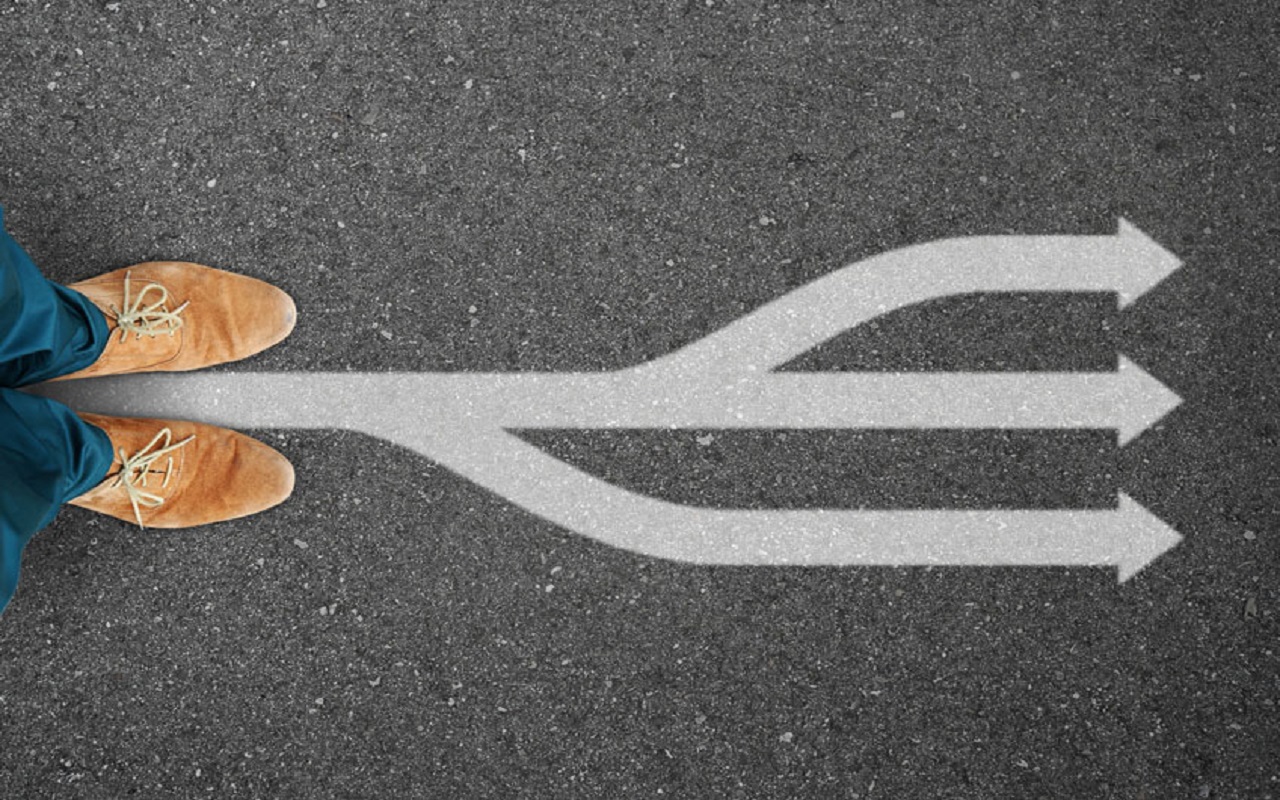
What do the people higher up in the company hierarchy have in common? They are on average better at making decisions and taking risks.
Making decisions is a skill that is independent of intelligence. If anything, higher intelligence may make it harder to practice the skill. The combination of these two things means that often, the people who have the top positions and are on average more successful in life, are not necessarily the most intelligent people.
What does this mean for you?
To get what you want in life, you need to master the skill of decision-making.
Becoming proficient in decision making makes it easier in all parts of life. From progressing your career, starting a business, improving your health, getting and maintaining a healthy relationship and so on.
The reason decision-making is so powerful is because the easier and quicker you take decisions, the more experience you will gain in a large variety of skills, and over time these extra skills you have over less decisive people will make you more capable and attractive.
Making decisions though is directly linked to risk taking. The core reason why people struggle with decisions is because every decision carries risk. Most people would rather take the risk of doing nothing because the consequences feel out of their control, so they can blame it on things other than themselves.
So to become better at decision making, you need to be able to evaluate risks as well.
How do you practice both skills?
The first thing is to internalise that indecision always carries more risk than a bad decision. Indecision may keep your body alive but your spirit will drown. That makes it easier to force yourself to make decisions, but how do you decide between 2-3 or more paths?
Always take the path that is easiest based on your values and boundaries. For example, most people would not want to use manipulation to gain advantage at work which is a good value. But most people get taken advantage of because they do not make concrete decisions on what role they want to get, what salary they want to get and how quickly they want to get it. Often, making the decision to job hop can massively speed up salary increases, job satisfaction, and skills.
Another example – Starting a business. Most people care too much about the branding, the logo, the website name, the look and so on. Those don’t matter much at the start. If you had never heard of Google, would you ever name your search engine company Google? It means nothing until it does. So the decision you need to make is the easiest – how do I generate revenue and value. Once you have that down, you can hire people to make the decisions on the other less important tasks.
The next way to practise both skills is through evaluation
If I take this decision, it had this risk which I thought had this chance of occurring but actually it was lower/higher. If the risk was lower, then it means you can take that decision easier, if the risk was higher than you need to re-evaluate whether you should make the same decision in the future.
This evaluation is often subconscious but occasionally needs to be done consciously to make sure it sticks. It creates a positive cycle loop where you make decisions, learn the consequences, use that to make better decisions, learn even more consequences (good or bad) and so on until making decisions and evaluating risk is second nature to you.
Why are intelligent people often worse at decision making?
Because the more intelligent you are, the higher your analytical skills of risk. To take this to the extreme, someone who has 0 iq does not need to evaluate risk to make a decision. Everything they just do. On the other extreme, if you have infinite intelligence but limited “processing power” then you may end up spending your whole life analysing whether the risk of starting a business, changing jobs, moving countries, starting a relationship is worth it.
Intelligent people are closer to the upper extreme, they spend too long analysing, not enough making decisions and acting. Less intelligent people can sometimes do the opposite, they never evaluate their risks and continue making the same bad decisions over and over again.
So there is a sweet spot somewhere in the middle. But while intelligence may be genetic, knowdedge and skills can be learned and improved. So by using self-awareness you can figure out whether you need to do more risk analysis or tone it down and let chance do it’s thing.
One reason Elon Musk is a good business man is because he appears to have high iq and be a little autistic. This combination means that he can often make good decisions quickly because he does not take into account the social risks involved in his decisions.
Decisions are resource-intensive actions. Use them wisely.
You will have all heard how all billionaires have the same t-shirts and suits in the same colour so that they don’t have to “spend” a decision on what they wear each day. This is extreme levels but the methodology is sound. You should have standard responses to many possibilities in life so that you do not have to make a decision each time on what to do.
This is where boundaries and values come into place. For example – I have told myself that I will never give money to a homeless person who actively asks me to. This may sound horrible, but I really dislike the feeling of having to decide which homeless person I should give money to and which one to reject. You can’t give money to all of them. Instead, what I do is whenever I collect a certain amount of change, I say I will give it to the next homeless person I meet. What does this do? There is no decision making. It’s not emotionally draining. It lets me focus on making the decisions that have a bigger impact on me and the world.